If you or your friends and family live in the Bay Area, then you’ve probably been hearing a lot about the recent storm, leaving dozens of cities and cars flooded.
Tomo’s data team gives an inside scoop on what their customers were spending during this near-record worst rain storm in 173 years — and the purchase item might surprise you.
Usually, we see people buying items that are essential during a storm, like: non-perishable canned foods, first aid kits, umbrellas, and other winter storm gear. But the #1 item purchased from our Tomo customers were (drumroll, please) ~ dog collars/leashes. Yes, that’s right, pet-related items were #1 most purchased during the storm. I guess this makes sense since the COVID Pandemic resulted in a lot of new fur parents.
Did you know that on average, annual household spending in the U.S. on pets was $700 in 2022? TomoCredit consumer data shows that spending on pets among the GenZ population nearly DOUBLED during the pandemic!
Contact us to learn what the 2nd and 3rd most purchased items were during the SF storm.
BNPL has taken consumers by storm in the last few years. But these apps, like Klarna, Afterpay, etc. should not be expecting the same results from spenders in 2023.
Consumers this new year are much more diligent and smart with how they spend their money. With more tools and education on financial literacy and startups, like TomoCredit, placing the importance on smart spending, consumers are all ears (especially in this economy).
Consumers are finally being hit with the high interest they spent on their electronic devices from last holiday. They are learning from their mistakes and to not “bite on an easy hook.”
SF based startup, TomoCredit, announced that they’ve seen a huge spike in applications in 2022 because of their no interest/0 APR card feature. CEO and founder, Kristy Kim, explains that consumers are feeling the aftermath of easy spending with BNPL options, but don’t understand the repercussions until they see interest fees charged to their account.
Southwest Airlines recently announced a major failure on their end, resulting in the cancellation of over 15,000 flights. On average, U.S. consumers spend $450 of their holiday budget on travel and plane tickets, making it the top spend item.
Although Southwest has offered refunds and expense reimbursements, TomoCredit, SF based startup, wants to do more, immediately.
A closer look from Tomo’s data team shows that 20% of travel bookings were from Southwest Airlines. Tomo has received an abundant amount of disputes for the Southwest flights. As the dispute forms have been coming in, we have been doing our best and trying to go above and beyond for our members. We understand that they are going through a situation at no fault of their own, so we want to help any way we can.
What Tomo is doing to help:
Processing dispute claims, while our Customer Support goes above and beyond
5$ Lyft credit
We want our members to know that no matter the circumstances, Tomo cares and always has their back!
As many of us are planning our New Year’s Resolutions, it seems safe to say that Financial Resolutions usually make the top of the list.
This year, TomoCredit, an SF based startup, wants to help millions reach their highest credit score, as FAST as possible. TomoCredit is targeted towards GenZ and Millenials and aimed at helping those who don’t have any credit history/bad credit.
The TomoCard has some unique features that make it the best credit card of 2023 to help build credit fast. Here are 5 key features:
Weekly Autopay — this means on-time payments and 0 balance every week. Because of the weekly payoff, your healthy spending habits are being reported more frequently to all 3 credit bureaus (Experian, Equifax, TransUnion). Frequent reporting = credit building FASTER.
0% APR/interest — yes, you read that right
Up to $10,000 credit limit
SSN not required to apply!
Free benefits worth over $500!
So, what are you waiting for? Start your 2023 with Tomo.
This New Year, TomoCredit, a fintech startup based out of San Francisco, CA, wants to help you build credit even if you don’t have a credit history! (or if you simply need to rebuild your score).
The Tomo card, better known as “GenZ’s favorite credit card”, lets you build credit without having ANY credit history. The card also has 0% APR/interest and since it is MasterCard “World Elite,” there are a ton of perks for members, including: $1000 cell phone protection and Lyft/DoorDash/HelloFresh credits. Talk about a win-win!
The Tomo card also features weekly autopay, which allows users to boost their credit FAST. What better way to start the New Year than with good credit?! The Tomo card reports to all 3 credit bureaus — Equifax, Transunion, and Expedia.
So if you plan on buying a home, car, or any other expense requiring a loan, this card will help you reach your credit score goals.
Check out how we are on a mission to help millions of others reach their financial and credit score goals by visiting our website: tomocredit.com
Crypto has been viewed upon as speculative instruments, not payment mechanisms. While Bitcoin was originally intended to be a new world currency, it has transitioned to more as a hedge against inflation and a store of value. In a sense, spending Bitcoin would be a lot like spending Apple stock. Sure, you can spend it, but it would also be fairly regretful if the remainder of your holdings kept going up. The psychology behind this prevents users from making this a true payments system (unless you had a ton to get rid of).
However, with the advent of Stablecoins, the game has changed. Stablecoins are cryptocurrencies that maintain a $1 peg, which means that they are not meant to be speculative assets. Newer networks allow pretty amazing interest rates on top of these, but in general, these should not be any different than the $1 in your bank account, your credit balance, or in your wallet.
Stablecoins come in many forms, asset backed (like USDC), algorithmic (like UST), or a combination of both. In general, there are some controversies on how a stablecoin can maintain a peg even during volatile market conditions. But why is this so hard to spend today?
Take an example of how you’d have to do it:
01 Send to a crypto exchange To spend your crypto, you must first take it off any wallet or protocol you have it in, that means sending it to an exchange.
02 Trade to USD That’s right, just like any other crypto asset, you need to convert crypto on an exchange. Some offer free conversions from USDC, but otherwise you have to pay fees too.
03 Send to a Bank account Even with the benefits of crypto instant settlement, you still need to withdraw to your bank account after you sell on an exchange, which can take an extra day or two.
How TomoCredit is Solving the Payments issue
Tomo is a crypto wallet
We think making the core product a crypto wallet is important, that way you can have the safety of a custodial wallet.
Choose which coins to spend
We default to your stablecoins, but if you prefer to spend other crypto assets, you can choose them as a default.
Autopay automatically converts and pays off your card
No need to worry about trading or withdrawing, Tomo will automatically convert coins that are needed to pay off your credit balance. Spend your credit card like you normally would.
Empowering female tech employees amid the growing number of anti-abortion laws in the U.S.
After almost 50 years since the historic Roe v. Wade decision in 1973, more and more states have been looking for legal loopholes to put in place to make it harder for people to access abortion care. This trend exploded in September 2021 when The Texas Heartbeat Act (SB8), which bans abortions after six weeks, went into effect.
As a female, minority, andimmigrant founder of a company that employees people of color across the U.S., I’ve been angry and sad to read the news that abortion laws are now in jeopardy. When I left my home country in South Korea as a young girl, I thought America is the place where women and men are truly equal and women can reach their full potential through their careers.
Guess I was wrong. However, the good news is that now I am in charge. I am in charge of one of the fastest growing private companies in the U.S. I have the power to protect my people- especially women who refuse to live in fearof forced pregnancies and of having their bodily autonomy ripped away from them.
At TomoCredit, we believe in human rights and we believe in empowering women to be fully in charge of their own bodies, own careers, and own dreams. To help facilitate this TomoCredit will:
Cover 100% of legal expenses up to $5,000 if any employee (or their partner) suffers legal issues as a result of anti-abortion laws
Contribute up to $2500 towards travel expenses for employees (or their partners) needing to travel out of state for abortion care
Contribute up to $2500 for out-of-pocket medical costs for an employee (or their partner) in need of out-of-network abortion care
At TomoCredit women’s rights are human rights and we will continue to empower women everywhere.
In a Global Financial Literacy Excellence Center study, female participants answered 49% of personal finance questions correctly while male participants answered 56% of them correctly. Although both these scores are very low and need to be brought up significantly, the interesting findings were about the gender gap in financial literacy as the study also found that women did significantly worse in questions about borrowing, saving, earning, and investing than men. This knowledge impacts every aspect of your life from the decisions you make to the ones you don’t make.
Another result of the study is that women answered “don’t know” to 25% of the questions compared to 20% for men. This suggests that it may not only be lack of knowledge creating the gap, but also lack of confidence. Another study by GFLEC found that when the “don’t know” option wasn’t available, female participants often chose the right answer. This study credited lack of confidence for one third of the gender gap. In personal finance this may look like not wanting to invest or take risks, trusting others more than yourself, or feeling like you do not have the tools to even get started. Consider finance bros, Wall Street Suits, and khaki wearing car salesmen. These typical symbols of finance are all male and as you can imagine, they represent the male majority which can be intimidating. A way to combat this is through education and experience by seeing exactly what you can do for your finances instead of letting it stay a large unknown.
Educating yourself can be the hardest first step because it requires you to confront what you do not know. Admittedly, finance has many moving parts and can become convoluted, but you don’t need to open a Roth IRA tomorrow. The first steps can be as simple as calculating your income and expenses to stay mindful of spending. Everyone starts from knowing nothing and learns through watching and learning from others. Instead of being intimidated by people who are more knowledgeable about finance, start with videos, books, or sites that are your level and build up slowly. As we have seen, the confidence to start and trust in yourself makes a very large difference.
There isn’t one easy solution for fixing the gender gap in financial literacy. However, progress starts with empowerment and creating an environment where women can believe in themselves. Technology has made it easier to take control of your finances but we also cannot forget the women in the field who are paving the path like Tomo CEO Kristy Kim and allowing women to see themselves in the finance world. Although they may take a little longer to find, there are plenty of women in finance who you can bank with, learn from, and emulate.
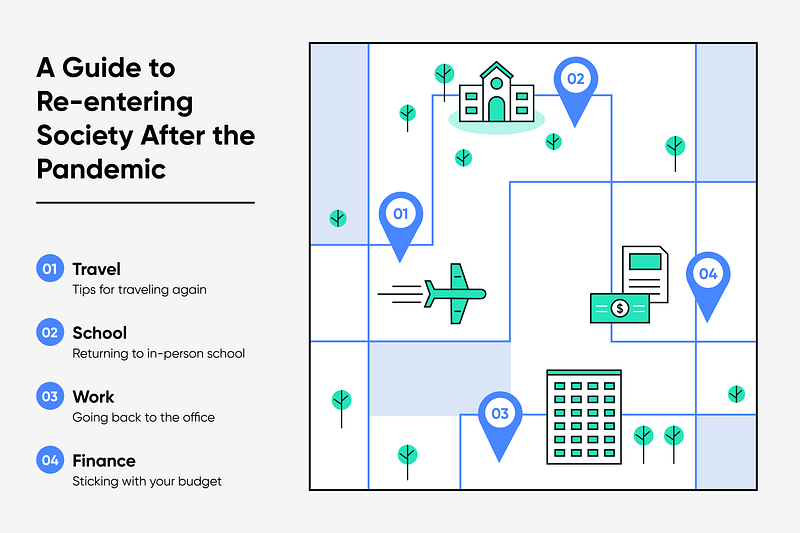
Just a few weeks in, this summer has already proven to be different from the last — the previous year’s uncertainty unsurprisingly resulting in a comeback season for many who are making up for lost vacation time. This moment can feel like a second chance at fulfilling the plans that were postponed for longer than initially anticipated. However, it can also feel sudden and a little overwhelming to have so many places and opportunities open back up. Here is our guide to help you ease your transition back into a post-pandemic society.
Traveling
The TSA checkpoint travel numbers are reporting a more than 3x increase in daily traveler numbers in June of this year compared to last year, meaning that you may need to take some extra time to prepare yourself for the next time you grace the floors of your nearest airport. Before you plan that next trip though, make sure you do your research on travel guidelines and local mandates to avoid getting caught off guard. While many countries are slowly opening up their borders to Americans, keep in mind that there will likely still be requirements for unvaccinated travelers. If you are planning on traveling anytime soon, it’s best to make sure that you and those around you are protected by getting vaccinated if you haven’t already done so!
School and Work
The idea of returning to work and school in person can be overwhelming, to say the least. Schools across the country are re-opening their doors to students and teachers after more than 1.5 years of offering remote learning. The academic rigor of online learning has not been easy, so it will take some time to transition back to the routine of in-person classes. Students should know that their schools’ mental health resources are there to help them with this. The same goes for anyone returning to working in person. Make sure to know the details of your company’s transition period and what services and resources are available for you to make this easier on you. Don’t be afraid to ask questions and voice your concerns — chances are, there are others thinking the same thing.
Budgeting
Going out more usually means spending more money. It’s awesome if you were able to develop healthy saving and spending habits during quarantine! Make sure to keep this same energy once your friends are inviting you out every weekend, you don’t want to undo all your hard work. Overspending will be easy, but if that happens don’t get discouraged! There are many ways to manage your budget and build mindful spending habits, just take a look at our previous blog posts for tips.
Investing. Budgeting. Debt. For many who have never dabbled in the field of personal finance, these finance phrases can seem intimidating — but fear not! The field of personal finance presents beneficial knowledge in regards to managing an individual’s monetary resources. With summer break upon us, it provides a perfect opportunity for you to learn and work independently. Here are our top 5 personal finance book recommendations that are a great place to start.
Rich Dad Poor Dad
This book, written by Robert T. Kiyosaki, explores the author’s learning experiences from two father-figures and their different money-management strategies. It delves into the concepts of smart investing, earning money without necessarily having a high income, and how to maintain long-term acquisition of wealth. No matter what age group, this insightful book offers diverse perspectives on the concept of earning money and is an excellent read for those interested in developing their long-term personal finance skills.
Broke Millennial
Geared more towards the younger generation, Broke Millennial: Stop Scraping By and Get Your Financial Life Together by Erin Lowry presents a variety of tips for those who are just beginning their journey towards financial independence. It covers topics such as investing, budgeting, planning, avoiding credit card debt, and much more. If you are a beginner looking to learn about these personal finance concepts, this book is for you!
I Will Teach You to Be Rich
I Will Teach You to Be Rich by Ramit Sethi is another resource that is perfect for college students or individuals starting out on their personal finance journey. It provides helpful advice on paying off loans and other debts, how to navigate late fees, and basic investing knowledge. It also gives recommendations on making future large-scale purchases in life such as property and vehicles. Overall, it is an excellent educational read for the younger generation who are beginning to face these real-world financial decisions.
The Millionaire Next Door
Thomas J. Stanley’s The Millionaire Next Door: The Surprising Secrets of America’s Wealthy is a helpful book that has had a significant impact on people’s understanding of what it truly means to be “rich” in America. It consolidates research findings revealing traits shared by those who have accumulated notable amounts of wealth, such as their saving practices, financial habits, and more. This book is a great fit for anyone looking to increase their wealth and develop healthy personal finance skills to do so.
Your Money or Your Life
Another resource for students in college or beginners to personal finance, Your Money or Your Life,by Vicki Robin and Joe Dominguez, shares nine steps that can be taken to achieve financial independence. It goes into detail about avoiding debt, maintaining living expenses, and keeping in mind the importance of your financial impact on the planet. This book promotes healthy as well as sustainable financial habits and is a great read for those who want to practice effective and responsible lifestyle choices.